Supreme Rest · Materials
The fabric that determines the quality of your sleep
A 2024 Journal of Sleep Research study confirmed: body temperature decreases by 1.5°C during sleep, and the bedding fabric directly affects this process
Science confirms
Why fabric is not comfort, but physiology
During sleep, the body lowers its core temperature by 1–2°C – this is a prerequisite for entering the deep phase. The fabric of your bedding either aids or hinders this process.
-
−1.5°C
Decreased body temperature
during deep sleep — a necessary condition for recovery
-
0.5–1 L
Sweating every night
the fabric must wick away moisture – otherwise it accumulates what mites thrive on
-
2024
Journal of Sleep Research
confirmed the direct impact of bedding on sleep quality
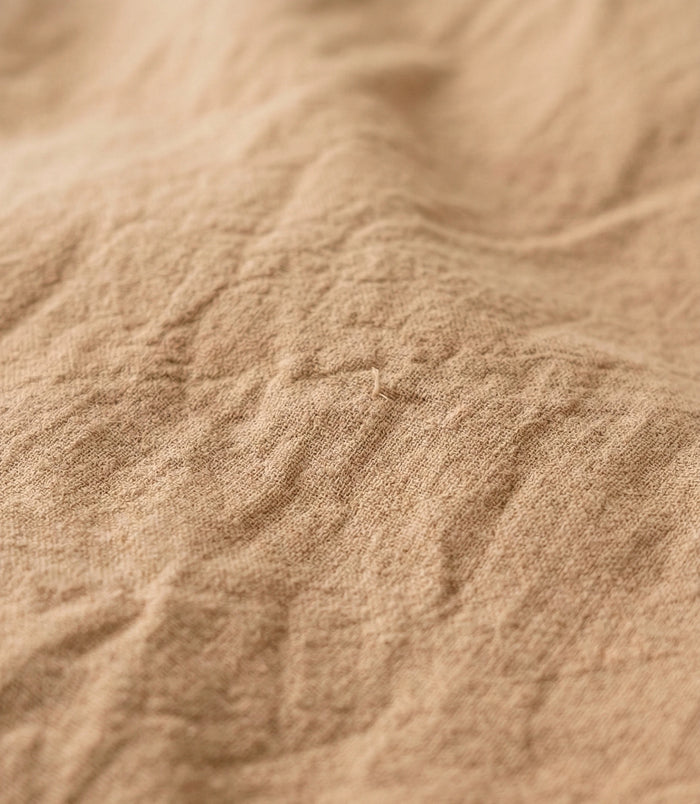
Boiled cotton
Cotton that has undergone enzymatic treatment and become softer during production
Washed cotton is regular cotton treated with enzymes and a special thermal technology. The fibers are opened and "worn out" under controlled conditions. You get the result of 20–30 home washes even before the first use — with no chemicals on your skin.
Manufacturing know-how: enzymatic treatment = 20–30 home washes. The fabric is already stabilized — it will no longer shrink or deform from day one.
Benefits
- Soft from first use
- Minimal creasing
- Stable size after washing
- Gentle on sensitive skin
- OEKO-TEX certified
Suitable for
- Those who value softness
- People with sensitive skin
- For children's rooms
- Gift sets
- Year-round use
Fabric care
- Wash at 40°C, delicate cycle
- Do not bleach with chlorine
- Dry flat
- No ironing needed or iron at 110°C
- Do not use fabric softener
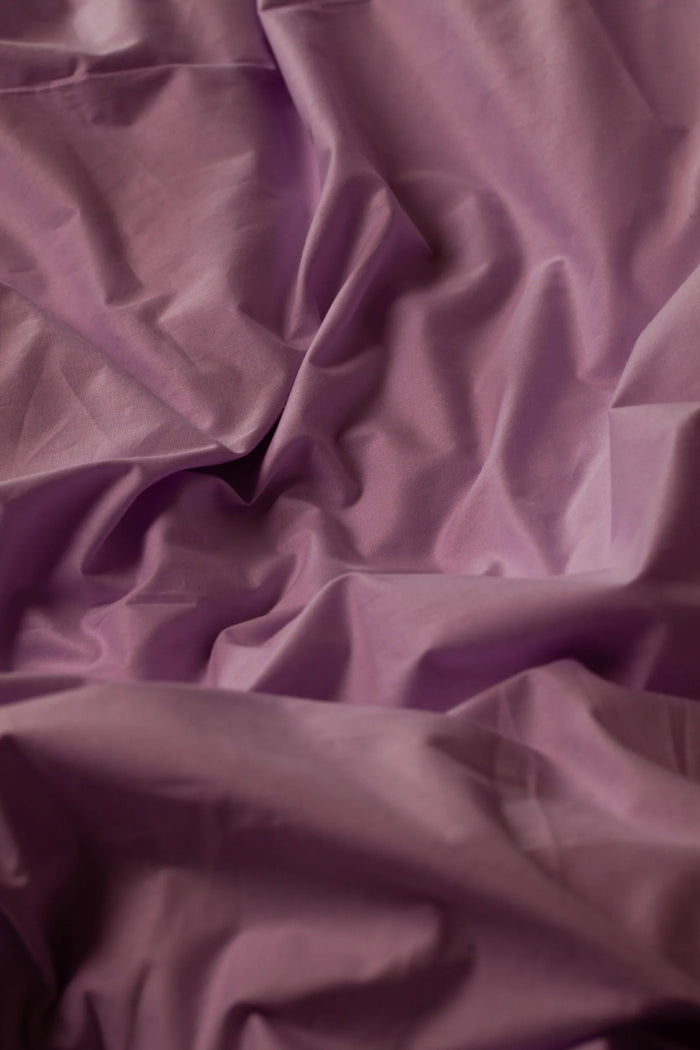
Ranforce
Fabric chosen by hotels, hospitals, and people for whom durability is important
Ranforce (poplin) is a plain weave with even threads of uniform thickness. It has been used in French hotels and children's hospitals for over 600 years. The fabric does not deform with frequent washing at 60°C and retains its shape for decades.
Key advantage: withstands washing at 60°C without loss of structure – real hygienic treatment for allergy sufferers and families with children.
Benefits
- Washable up to 60°C without deformation
- Lasts 5–7 years or more
- Breathable structure
- Minimal creasing
- High hygiene
Suitable for
- Families with children
- Allergy sufferers
- Those who value practicality
- For frequent washing
- HoReCa and hotels
Fabric care
- Wash at 40–60°C
- Wash with similar colors
- Dry flat
- Iron at 150°C while damp
- Do not use chlorine-based bleaches
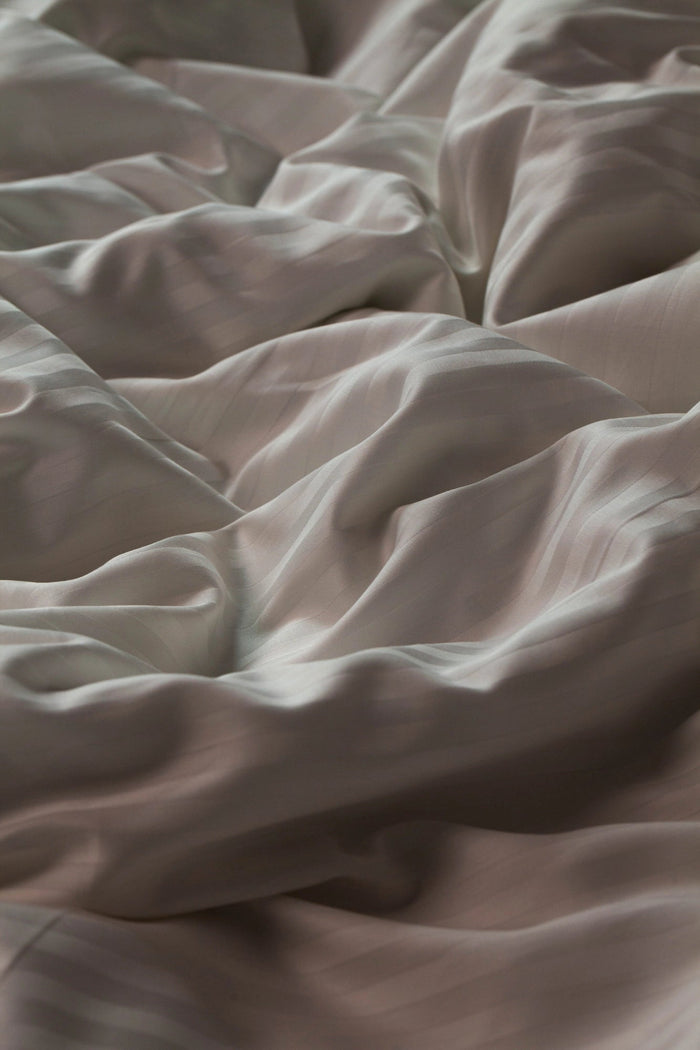
Stripe satin
100% cotton with a 4:1 weave that reflects light like silk — naturally and without coatings
Stripe sateen is a 100% cotton fabric with a 4:1 sateen weave, in which the warp thread covers several weft threads, thereby reducing the number of intersections and making the surface smoother and softer. This structure creates a characteristic silky sheen on the face side, while the reverse side remains matte. The striped pattern is formed not by printing, but by the weaving method itself — alternating sections with different orientations of the sateen weave, which reflect light differently. It is a dense, breathable, and durable fabric that combines the naturalness of cotton with a distinctive texture and elegant appearance.
Important to know: the initial touch is cold. However, the dense 4:1 weave retains heat — after 15–20 minutes, sateen becomes warmer than ranforce. Not recommended for those prone to overheating at night.
Benefits
- Silky sheen without synthetics
- Elegant look in the bedroom
- Pleasant cool touch
- Minimal creasing
- 100% cotton, OEKO-TEX
Suitable for
- For those who appreciate aesthetics
- Winter season
- For those who are cold at night
- Premium gift
- Romantic atmosphere
Fabric care
- Wash at 30–40°C on a delicate cycle
- Do not bleach
- Dry away from direct sunlight
- Iron at 150°C on the inside
- Do not use fabric softener
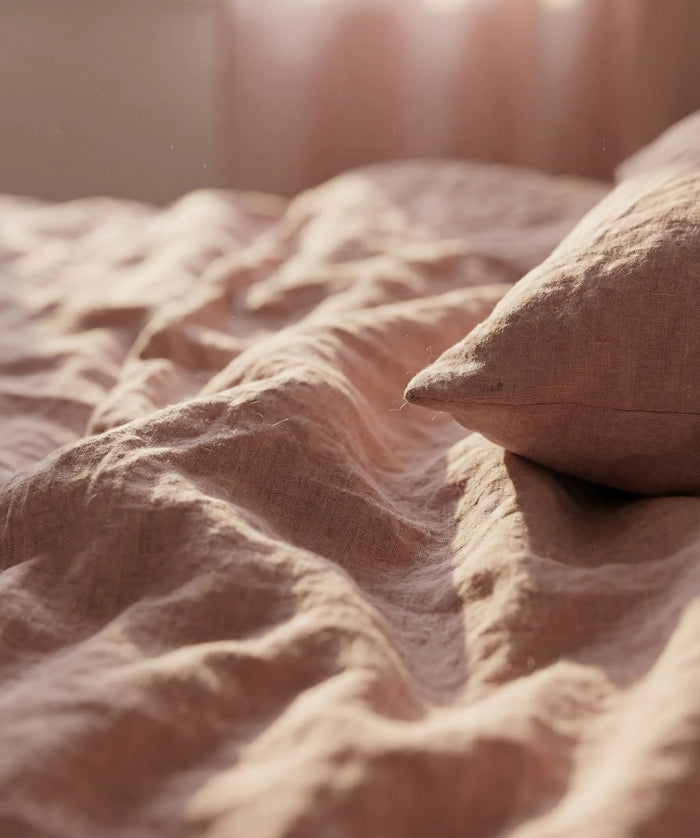
Flax
The only natural fabric with bidirectional thermoregulation — cools in summer, warms in winter
Linen fiber is hollow inside, like a tube. This allows it to wick away sweat 4 times faster than cotton while also retaining warmth in winter. The initial stiffness comes from natural pectin (the same substance found in apples). It washes out during laundering.
Unique property: linen is the only natural bidirectional thermoregulator among textiles. It wicks away sweat 4× faster than cotton and retains warmth in winter.
Benefits
- Wicks sweat 4× faster
- Cools in summer, warms in winter
- Lasts 10+ years
- Antibacterial properties
- Softens with every wash
Suitable for
- For those who sweat at night
- Hot summer and cold winter
- For those who value durability
- Eco-friendly choice
- Hypoallergenic skin
Fabric care
- Wash at 40°C, delicate or standard program
- Initial washes — 3–5% shrinkage is possible, consider when choosing size
- Dry flat or machine dry on low heat
- Iron while damp at 200°C or do not iron
- Do not use softeners or bleaches
Myth vs Fact
Debunking the main myths
Marketing and outdated advice. Here's what's actually happening with the fabric.
Myth
the higher the thread count, the better the fabric
Fact
A thread count of over 400–500 is often just marketing. Manufacturers twist 2–3 weak threads into one and count each separately. The result: a heavier, stiffer fabric with less durability.
Myth
"100% natural" guarantees skin safety
Fact
Even 100% natural cotton can contain residues of formaldehyde and azo dyes. OEKO-TEX Standard 100 tests for over 1000 potentially harmful substances.
Myth
Bed linen should be washed infrequently so it doesn't wear out
Fact
A person sweats 0.5–1 liter at night. Millions of dust mites accumulate in the bed over a week. Bedding should be washed every 1–2 weeks – quality fabric will only benefit from this.
Myth
Fabric softener makes bedding better
Fact
Softeners cover the fibers with a chemical film, which blocks breathability and gradually destroys the structure of natural fibers. They are the enemy of linen and boiled cotton.
Myth
Boiled cotton becomes significantly softer after each wash
Fact
The main fiber transformation has already occurred during manufacturing. Changes after home washing are minimal. This is an advantage: you get stable, predictable results from day one.
Myth
Ranforce is a cheap, budget fabric without any special advantages
Fact
Ranforce (poplin) is used in French hotels and children's hospitals due to its combination of durability, hygiene, and ability to withstand frequent washing at 60°C. It is a functionally perfect fabric.
Myth
Stripe sateen cools — perfect for a hot summer
Fact
The initial feeling of coolness is real. However, the dense 4:1 weave retains body heat, and after just 15–20 minutes, satin becomes warmer than ranforce. For hot sleepers in summer, choose ranforce or linen.
Myth
Stripe sateen is "synthetic satin."
Fact
Satin is a type of weave, not a material. Supreme Rest Stripe Satin is 100% cotton. The sheen is created by physics: the threads reflect light in parallel, like a mirror, without any coatings.
Myth
Linen is prickly and will remain so forever
Fact
Initial stiffness is natural pectin in the fiber, the same substance found in apples. It dissolves in water during washing. After 10–20 washes, linen reaches its true silky softness.
Myth
Linen—only for Scandinavian interior design
Fact
Linen suits any style: from minimalism to classic. It was used in Egyptian palaces, Roman villas, and French chateaus. Today, it is a universal premium material.
Myth
More expensive bedding is always better — quality is proportional to price
Fact
Ranforce (the most affordable fabric in the range) withstands 200+ washes without deformation and allows washing at 60°C — which is why it's used in hospitals and hotels worldwide. Linen — the most expensive fabric — is also the most durable and the only one that improves with age. The price reflects the labor intensity of production, not the quality of sleep.
Myth
Bedding "breathes" — meaning it always cools
Fact
"Breathing" and "cooling" are different things. Ranforce and linen breathe and cool. Stripe sateen breathes (it's 100% cotton), but retains warmth due to its dense weave. Washed cotton breathes and is temperature-neutral. Synthetics don't breathe at all, yet are also sold as "breathable."
Comparison
Choose the fabric that suits your sleep style
Honest comparison based on key parameters — no marketing.
| Feature | Boiled cotton | Stripe sateen | Flax Recommended | Ranforce |
|---|---|---|---|---|
| Feel and comfort | ||||
| Softness | Very high | High | Grows with washing | Average |
| Cooling effect | Neutral | It's tangible | Sustainable | Neutral |
| Thermoregulation | Good | Average | Excellent | Good |
| Warehouse and Health | ||||
| Natural composition | 100% cotton | 100% cotton | 100% linen | 100% cotton |
| OEKO-TEX Standard 100 | Yes | Yes | Yes | Yes |
| Hypoallergenicity | Tall | High | Very high | Very high |
| Suitable for children | Yes | With caution | Yes | Perfect! |
| Practicality | ||||
| Creasing | Minimum | Minimal | Noticeable | MinimalMinimal |
| Is peeling | No | No | No | No |
| Shrinkage after washing | ≤2% | ≤2% | 3–5% | ≤2% |
| Washing temperature | 40°C | 30–40°C | 40°C | 60°C |
| Ironing | Not needed | Not needed | Recommended | Not needed |
| Durability | ||||
| Service life | 3-5 years | 3–4 years | 10+ years | 5–7 years |
| Washability (1–5) | 4 | 3 | 5 | 5 |
| Improves with washing | Partially | No | Yes | No |
| Cost and style | ||||
| Price range | Average+ | Premium | Suite | Average |
| Character | Everyday | Elegant | Any | Minimalist |
| View: | Boiled cotton | Stripe sateen | Flax | Ranforce |
FAQ
Questions about fabrics
Most frequent questions from our customers — with honest, non-marketing answers.
What is the best fabric for hot climates or summer?
For allergy sufferers, the best choice is ranforce or linen with an OEKO-TEX Standard 100 certificate. Ranforce can withstand washing at 60°C, which destroys dust mites and bacteria. Linen has natural antibacterial properties. Both fabrics contain no synthetic components and do not cause skin irritation.
What kind of bedding is the softest?
Boiled cotton is the softest from day one of use due to industrial enzyme wash treatment. Linen becomes the softest after 2–3 months of regular use, as its natural pectin washes out. Stripe sateen has a characteristic silky smoothness. Ranforce is pleasant, but without a "fluffy" effect.
What bedding to choose for children?
The optimal choice is ranforce: it withstands 200+ washes without losing shape, allows washing at 60°C for disinfection, and is resistant to pilling and deformation. Washed cotton is also suitable: soft and hypoallergenic. Stripe sateen and linen are less practical for active children's use.
How does washed cotton differ from ranforce?
Both fabrics are 100% cotton, but with different types of processing and weaving. Washed cotton undergoes an enzyme wash – the surface becomes textured and very soft from day one. Ranforce is a dense 1:1 plain weave without special treatment: smooth, light, and very durable. The first is for feel; the second is for longevity.
Why shouldn't you add fabric softener?
Softeners form a chemical film on the fibers, which blocks natural breathability and hygroscopicity. For all natural fabrics—especially linen and washed cotton—this destroys the very essence of the material. Natural softness is achieved simply by washing with water without chemicals.
What is the difference between stripe sateen and regular satin or synthetic sateen?
"Satin" is a type of weave (4 threads over the surface, 1 underneath), not a material. Our stripe-satin is 100% cotton: it breathes, absorbs moisture, and withstands regular washing. Synthetic "atlas" or polyester "satin" does not breathe, accumulates static, and is not a natural material.
Why is linen bedding stiff at first—and what to do about it?
Stiffness is natural pectin in linen fiber (the same substance as in apples and citrus fruits). It gradually washes out with each wash. After 10-20 washes, linen reaches its characteristic softness. You can speed up the process by pre-soaking the sheet in warm water for 30 minutes before the first wash.
What does the OEKO-TEX Standard 100 certificate mean?
OEKO-TEX Standard 100 is an independent international certification (established in 1992) that confirms: every component of the product – fabric, threads, dyes, and accessories – has been tested for over 1000 potentially harmful substances: formaldehyde, heavy metals, azo dyes, and pesticides. The criteria are updated annually. Bed linen is tested under Class II (direct contact with skin).
What kind of bedding is suitable for allergy sufferers?
All four Supreme Rest fabrics are hypoallergenic — they are OEKO-TEX certified and free of synthetic impurities. Best for allergy sufferers: linen (natural phenolic acids inhibit bacteria) or pre-washed cotton (enzyme wash removes residues of finishing agents — a common allergen in new fabrics).
Quality confirmed
OEKO-TEX Standard 100 — a standard we stand by
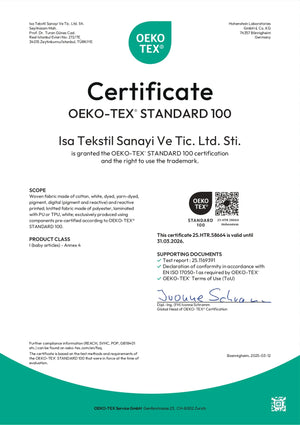
Each Supreme Rest fabric undergoes independent testing according to the international OEKO-TEX Standard 100. Over 1000 potentially harmful substances — formaldehyde, heavy metals, azo dyes — in every batch.
Choose bedding